
Padre Terminal on Base, BNB Chain and Solana: What Changes
Same Padre interface, different rules per chain: gas, speed, MEV, token standards and rug patterns on Base and BNB Chain compared with Solana.
Padre Terminal gives you one interface for Solana, Ethereum, Base, BNB Chain, but the chains behave differently underneath, and settings that work on Solana will burn you on Base or BNB Chain. Padre terminal crypto trading is the same screen everywhere and a different game on each network. This is the cheat sheet we keep next to the terminal.
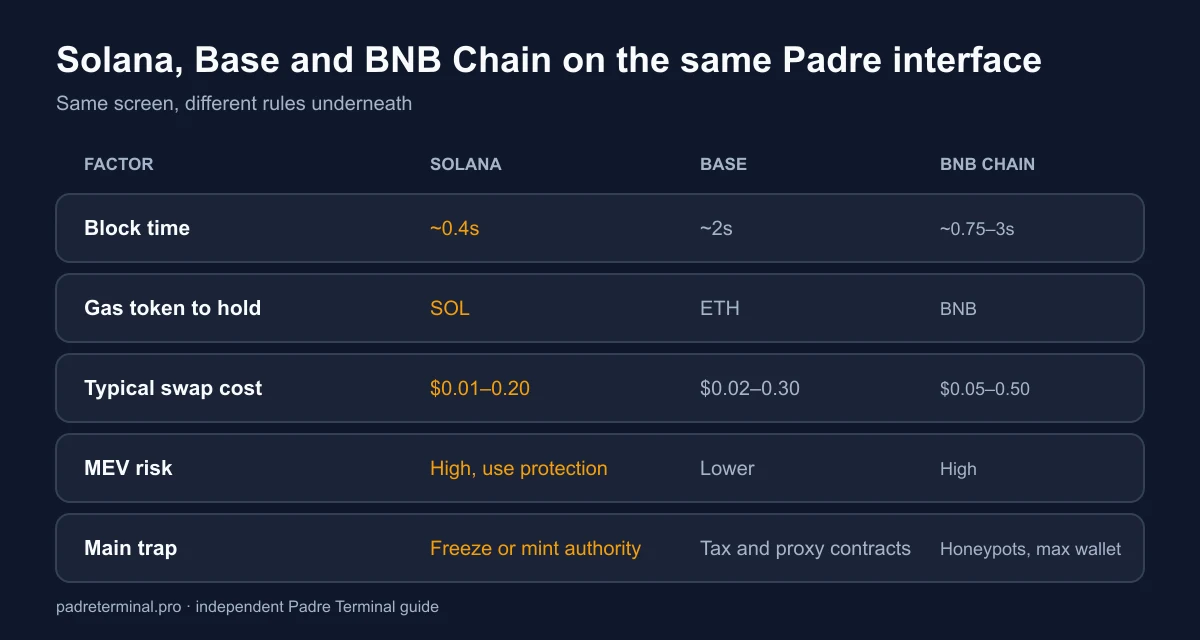
Side by side
| Factor | Solana | Base | BNB Chain |
|---|---|---|---|
| Block time | ~0.4s | ~2s | ~0.75–3s |
| Typical swap cost | $0.01–0.20 incl. priority | $0.02–0.30 | $0.05–0.50 |
| Gas token you must hold | SOL | ETH | BNB |
| MEV risk | Sandwiches common; Jito protection available | Lower on Base's sequencer; private RPC still helps | High; public mempool, sandwich bots active |
| Token standard traps | Freeze/mint authority, token-2022 transfer fees | Tax tokens, blacklists, proxy contracts | Tax tokens, max-wallet limits, honeypots |
| Launch venues | Pump.fun, Raydium, Meteora | Uniswap v3/v4, Aerodrome, launchpads | PancakeSwap, Four.meme |
| Rent / account cost | ~0.002 SOL per new token | None | None |
Solana on Padre: speed, but rent and priority games
Everything is fast, which means everyone else is fast too. Priority fee is the lever: Medium for most trades, High only in the first minutes of a hyped launch. Remember the ~0.002 SOL token-account rent on every new token; it is refunded on a full sell but makes tiny trades uneconomic. MEV protection is worth turning on for anything with slippage over 10%. If a transaction sits unconfirmed and then vanishes, that is normal Solana behaviour rather than a Padre bug: unconfirmed transactions expire and are dropped, as the Solana transaction reference explains.
Base on Padre: cheap and calmer, but slower fills
Two-second blocks mean your "instant" buy lands in the next block. In practice that is fine; sandwich risk is lower because Base has a single sequencer and no public mempool in the Solana sense. Watch for tax tokens (a % taken on every transfer, which breaks limit orders and shows as unexpected slippage) and proxy contracts the deployer can upgrade. Padre's Smart Scan flags tax; verify it before setting take profits. Base is an Ethereum L2, so the tokens follow the ERC-20 standard and anything unusual in transfer behaviour is written into the contract; the network's own documentation is at docs.base.org.
BNB Chain on Padre: highest rug density
BNB Chain memecoins have the most honeypots and max-wallet traps of the three. Read the contract flags on the token page carefully, keep slippage tight (5–8%) so a hidden tax fails the trade instead of eating it, and always test-sell a tiny amount before sizing up. Priority is less useful here; a private RPC / MEV-protect toggle matters more.
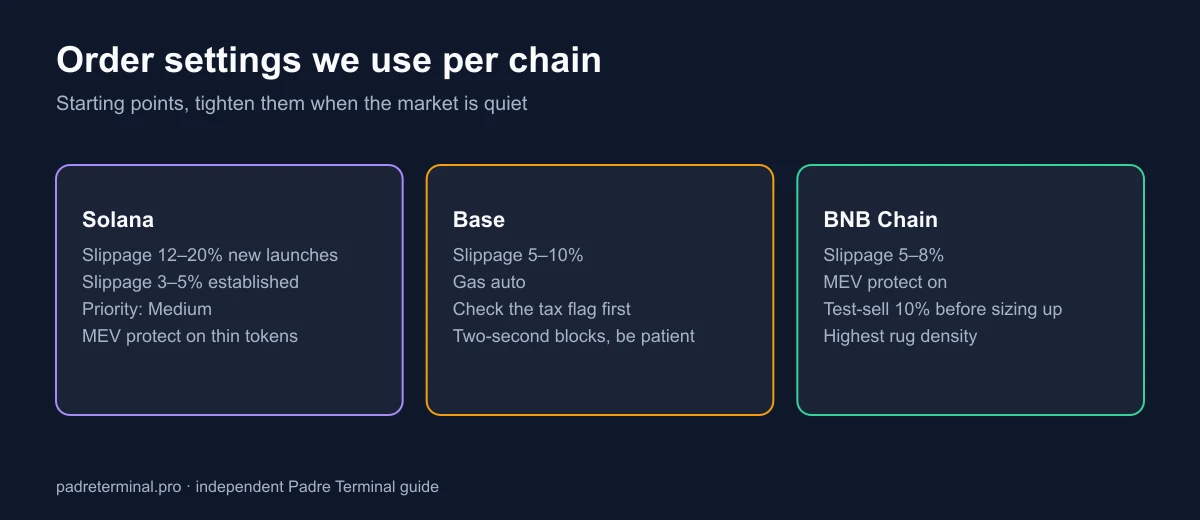
Padre settings we use per chain
- Solana: slippage 12–20% new launches, 3–5% established; priority Medium; MEV protect on for thin tokens.
- Base: slippage 5–10%; gas auto; check tax flag before every buy.
- BNB Chain: slippage 5–8%; MEV protect on; test-sell 10% first.
One account, separate wallets
Padre creates one wallet per chain under your login. Each needs its own gas token and its own private-key backup. Withdrawals are per chain too; see how to withdraw from Padre. Cashback accrues per chain in Rewards and is claimed per chain.
Which chain should you actually trade?
If you are picking one to learn on, pick Solana. Not because it is safest, but because the volume is there, the fees are small enough that a mistake costs cents, and almost every guide you will read assumes it. Base is the calmer second: fewer launches, longer-lived tokens, fewer sandwich attacks. BNB Chain pays the best when it works and has the highest density of outright traps, so it is the worst place to learn and a reasonable place to trade once you read contracts quickly. The network documentation is at bnbchain.org if you want the chain's own view.
Spreading across all four at once is the common beginner error. Each chain needs its own gas buffer sitting idle, its own backup, and its own mental model of what a normal fee looks like. Learn one, then add.
What moving between chains costs you
Padre does not bridge for you. Moving value from Solana to Base means an external bridge or an exchange, which costs time and a fee, and bridging is historically one of the riskiest things you can do in crypto. In practice we keep a working balance on the chain we trade most and treat the others as separate accounts rather than one pot of money. If you only ever trade Solana, the multi-chain support is a tab you never open, and that is fine.
Chain choice is mostly about where the action is that week. What does not change: the memecoin safety checklist before every buy and a stop loss right after.
BaseBNB Chainmulti-chain