
Padre Crypto Trading for Beginners: The First Five Stages
A beginner path to Padre crypto trading: the eight terms that matter, securing the wallet, sizing a first trade, the real cost floor and five common mistakes.
If you have never traded on-chain, Padre Terminal looks like a cockpit: four chains, a wall of tickers, numbers moving every second. Almost none of it matters on day one. This is the shortest honest path from nothing to a first trade you understand, and the order we would teach it to a friend.
What Padre crypto trading actually is
Padre crypto trading is not exchange trading with a different logo. Padre is a trading terminal, not an exchange. There is no company holding your balance, no order book run by an operator, no deposit account. It is an interface that signs transactions from a wallet you control and sends them to decentralised exchanges on Solana, Ethereum, Base and BNB Chain. Nobody can freeze your funds and nobody can recover them either. The overview is in padre trading terminal.
Two consequences worth internalising before you fund anything: every trade is public and permanent, and the tokens most people trade here are memecoins with no revenue, no product and frequently no honest team.
The eight words Padre assumes you know
| Term | What it means in practice |
|---|---|
| Gas | The chain's fee for including your transaction. Paid in SOL, ETH or BNB. |
| Priority fee | An optional tip that gets you included sooner when the network is busy. |
| Slippage | How far the price may move against you before the trade is rejected. |
| Liquidity | How much money sits in the pool. Low liquidity means your own order moves the price. |
| Price impact | How much your specific order moves it. Above 5% you are the market. |
| Rug pull | The team removes liquidity or dumps supply, and the token goes to zero. |
| Honeypot | A contract that lets you buy but not sell. |
| Bonding curve | A launch mechanism where price rises with each buy, before a real pool exists. |
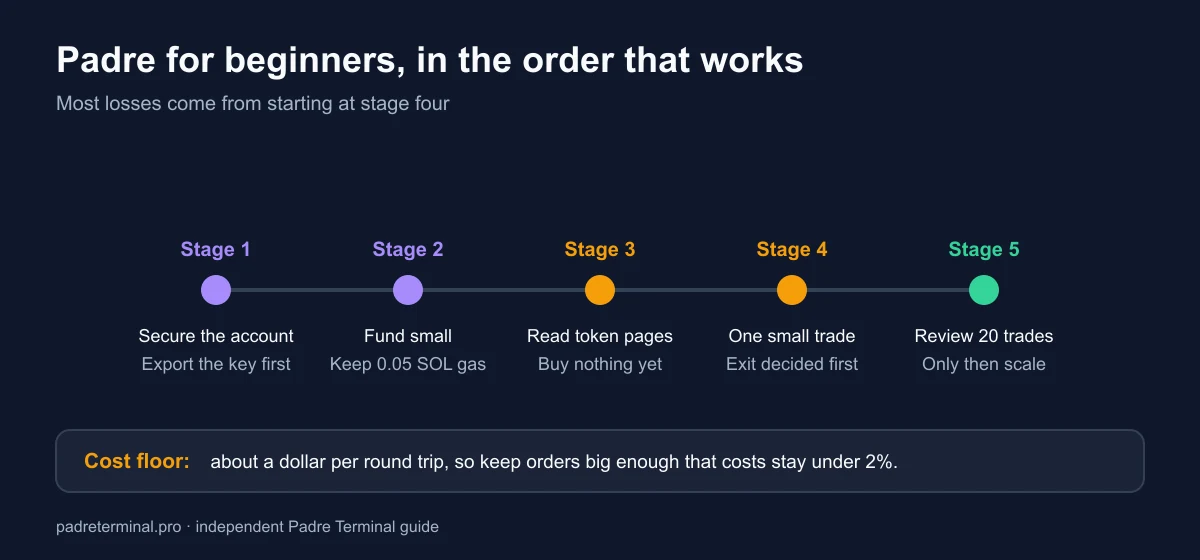
The five stages of learning Padre
1. Secure the account before it holds anything
Sign in at trade.padre.gg with Google, X or Telegram, set the wallet encryption password, then immediately export your private key to paper. The password cannot be reset and the key cannot be recovered. Details in Padre wallets explained.
2. Fund an amount you would not mind losing
Start with an amount that would annoy you rather than hurt you. Send a small test transfer first, confirm it arrives, then send the rest. Keep about 0.05 SOL untouched for gas, or nothing else will work.
3. Learn to read a token page before you buy anything on it
Spend your first session buying nothing. Open tokens, read Smart Scan, look at top holders, liquidity, dev holding and the age of the socials. Our check a token before buying routine is the drill; running it fifty times on tokens you do not buy is the cheapest education available.
4. Make one small trade with the exit already decided
Pick a token that passes the checklist. Decide, before clicking buy, what you sell at and where you cut. Then buy a small size, and set the take profit and stop loss immediately after the fill. The mechanics are in the 8-step setup guide and the order types in Padre limit orders.
5. Review before you scale
After twenty trades, look at the whole set rather than the winners. Count how many times you followed your own exit plan. Traders who lose money over a season usually followed it less than half the time.
What padre crypto trading costs on small orders
Fixed costs punish tiny trades. A platform fee of roughly 0.8% to 1%, priority fees of a few cents, and about 0.002 SOL of Solana token-account rent per new token add up to a floor of a dollar or so per round trip. On a $20 trade that is 5% before the price moves. Size so total costs stay under about 2% of the order, and read the Padre fee breakdown once properly.
The five beginner mistakes we see most on Padre
- No exit plan. Buying because it is moving, then deciding what to do while it falls.
- Position sizing by conviction. Conviction is not information about a token that launched nine minutes ago.
- Chasing the green candle. The people who bought lower need your liquidity to exit.
- Copying wallets blindly. Copy trading mirrors losing trades exactly as faithfully. See Padre copy trading.
- Leaving everything in the hot wallet. Profit is not profit until it is somewhere a browser cannot sign from.
An honest expectation
Most people who trade memecoins lose money, and the ones who do not usually got there by surviving long enough to learn, on sizes small enough to survive. Nothing on this site is a prediction or a recommendation to buy anything; it is documentation of how the tool works. Trade only what you can write off entirely.
Ready for the mechanics? Start with how to trade on Padre, and keep the Padre Terminal FAQ open for the questions that come up in the first week.
padre crypto tradingbeginnerspadre trading platform