Trading Pump.fun Bonding Curves on Padre: New, Soon, Migrated
How a Pump.fun token moves from bonding curve to real pool inside Padre, what stacks on the fee at each stage, and the settings we use per stage.
Since Pump.fun bought Padre in October 2025, the two products sit closer together than any other launchpad and terminal pair. That matters for anyone trading tokens before they migrate, because the bonding curve has its own pricing, its own fees and its own failure modes. Here is how the whole lifecycle looks inside Padre.
What the bonding curve actually is
A Pump.fun token does not start with a liquidity pool. It starts on a bonding curve: a formula that sets the price from the amount of the supply already bought. Every buy pushes the price up the curve, every sell walks it back down. There is no order book, no liquidity provider and no slippage in the usual sense, only your position on the curve.
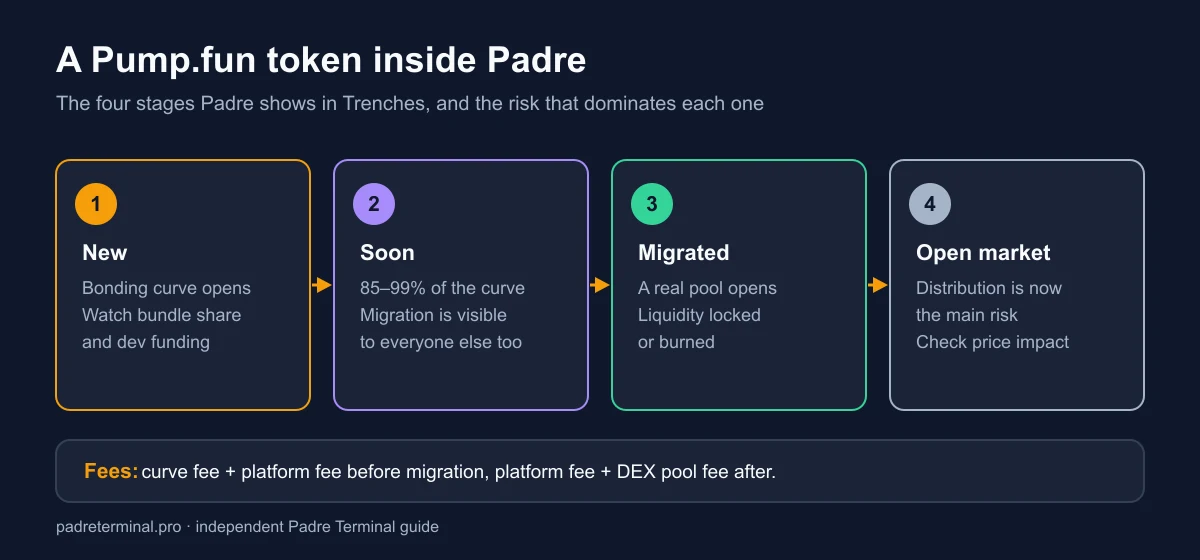
When enough of the supply is sold, the token graduates: the collected SOL is used to open a real pool (PumpSwap or Raydium depending on the launch), and from that moment the token trades like any other memecoin. Padre calls the stages New, Soon and Migrated in the Trenches columns, and shows the progress as a B. Curve percentage on each card.
Fees on the curve are not the same as fees after it
Two charges stack while a token is still on the curve: Pump.fun's own bonding-curve fee and Padre's platform fee. After migration you pay Padre's platform fee plus the pool fee of whatever DEX holds the liquidity. Public sources quote the curve fee anywhere from about 1% to 1.25%, and we have seen the combined number move, so treat any figure you read, including ours, as a starting point and read the confirmation panel in the app before you sign. The full breakdown of what Padre itself charges is on the fees page, and cashback applies to Padre's share only.
What to watch at each stage
New: the curve has just opened
Almost everything here dies. The two signals worth your attention are the bundle share (how much of the supply was bought in the deploy transaction) and the dev wallet's funding. A deployer funded from a fresh wallet minutes before launch, holding 20% through a bundle, is the standard shape of a rug. Our full pre-buy routine is the nine-point checklist.
Soon: 85% to 99% of the curve
This is the stage most active traders play, because migration is a scheduled, visible catalyst. The trap is that everyone can see it too. Buying at 98% and expecting a guaranteed pop ignores that the people who bought at 60% are waiting for exactly that liquidity. Size for the possibility that the pump happens without you.
Migrated: a real pool exists
Liquidity is now real and usually locked or burned, which removes the classic rug. The dominant risk shifts to distribution: a top-ten holder group above 30%, or a dev who kept a slice through the curve, can still walk the price down over hours. Price impact also becomes a thing again, so check it in the buy panel before sizing.
Settings that suit curve trading
- Slippage. On the curve, price moves with supply, so a busy launch can move several percent between your click and the block. We use 12–20% on New and Soon, and drop to 3–5% once a token is migrated and liquid.
- Priority fee. Medium is enough outside of a hyped launch. Raising it helps only when blocks are full.
- MEV protection. Worth turning on for anything thin, and the cost is a few cents. Details on the fees page.
- Exits first. Set a stop loss and a take-profit ladder as soon as the buy fills. On a migration play we take part of the position into the migration itself rather than holding for the second leg.
Does Pump.fun owning Padre change anything for you?
In practice it means the launchpad and the terminal are built by the same company, so curve data appears in Padre quickly and buying pre-migration is a first-class flow rather than a bolt-on. It does not mean the tokens are vetted, endorsed or safer. Pump.fun is a permissionless launchpad: anyone can deploy anything, and the overwhelming majority of what appears in the New column is worth nothing an hour later. What changed with the acquisition, and what did not, is covered in Padre is now Terminal.
If you are setting up Trenches to catch these tokens in the first place, the column filters and the sound alerts are explained in the filters guide.
Pump.funbonding curveTrenches